
Language, Text and Context
SECOND QUARTER 2020
SABBATH SCHOOL INSIGHT #7
MAY 16, 2020
“LANGUAGE, TEXT AND CONTEXT”
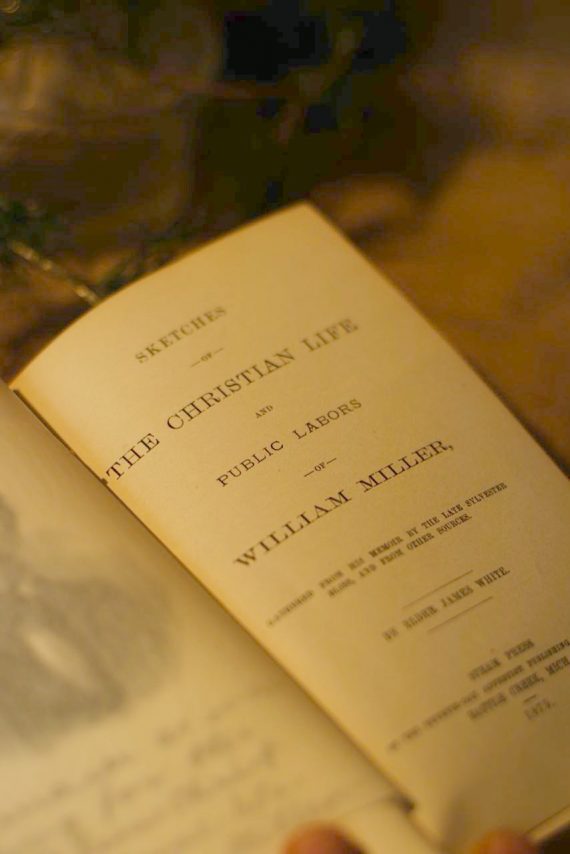
Have you ever read a verse in Scripture or heard it used so often and thought you knew what it meant? There is a significant danger with familiarity. Familiarity breeds contempt, but context brings perspective, delight and understanding. To have our erroneous views of Scripture released from the stronghold that tradition or established thought has clasped around it should be the goal of every student of Scripture. Jesus said, “You will know the Truth and the Truth will make you free.” John 8:32. This is what William Miller did. He got to know Christ and Christ made him free. Why William Miller[1] as a starting point? Because he is the best example of someone who knew both worlds of skepticism and belief—familiar territory to many of us—and eventually settled for belief. How did he do it?
First, he had an encounter with the Living God. He was miraculously spared during the 1812 war and in September of 1816 he experienced a conversion from Deism to Christ that was ignited during revival meetings in the local Low Hampton Baptist church. In his hopelessness he saw Jesus. He describes it like this:
“I saw that the Bible did bring to view just such a Saviour as I needed; and I was perplexed to find how an uninspired book should develop principles so perfectly adapted to the wants of a fallen world. I was constrained to admit that the Scriptures must be a revelation from God. They became my delight; and in Jesus I found a friend. The Saviour became to me the chiefest among ten thousand; and the Scriptures, which before were dark and contradictory, now became the lamp to my feet and light to my path. My mind became settled and satisfied. I found the Lord God to be a rock in the midst of the ocean of life. The Bible now became my chief study, and I can truly say, I searched it with great delight. I found the half was never told me. I wondered why I had not seen its beauty and glory before, and marveled that I could have ever rejected it. I found everything revealed that my heart could desire, and a remedy for every disease of the soul. I lost all taste for other reading, and applied my heart to get wisdom from God.”[2]
How did he get this wisdom from God? It was between 1816 and 1822 that he read through the Bible with only the Cruden Concordance in hand—laying aside all commentaries and pre-conceived ideas, he developed fourteen principles of Scriptural interpretation. What prompted this was that his former deistic friends became his most vicious opponents after he left their ranks and fell in love with Jesus—claiming the Bible as the Word of God. One of them challenged him with the question “How do you know it (the Bible) is true?”. His response was “Give me time, and I will harmonize all these apparent contradictions to my own satisfaction, or I will be a deist still.” Six years later he emerged a stronger Christian while developing immovable principles for interpreting Scripture. Here they are:
“WILLIAM MILLER’S RULES OF INTERPRETATION.
Every word must have its proper bearing on the subject presented in the Bible.
Matthew 5:18.All Scripture is necessary and may be understood by a diligent application and study.
2 Timothy 3:15-17.Nothing revealed in Scripture can or will be hid from those who ask in faith, not wavering.
Deuteronomy 29:29; Matthew 10:26, 27; 1 Corinthians 2:10 ; Philippians 3:15; Isaiah 45:11; Matthew 21:22; John 14:7, 13-15; James 1:5-6; 1 John 5:13-15.To understand doctrine, bring all the Scriptures together on the subject you wish to know; then let every word have its proper influence; and, if you can form your theory without a contradiction, you cannot be in error. Isaiah 28:7-29; 35:8; Proverbs 19:27; Luke 24:27, 44, 45; Romans 16:26; James 5:19; 2 Peter 1:19, 20.
Scripture must be its own expositor, since it is a rule of itself. If I depend on a teacher to expound to me, and he should guess at its meaning, or desire to have it so on account of his sectarian creed, or to be thought wise, then his guessing, desire, creed, or wisdom, is my rule, and not the Bible. Psalms 19:7-11; 119:97-105; Matthew 23:8-10; 1 Corinthians 2:12-16; Ezekiel 34:18-19; Luke 11:52; Matthew 2:7-8.
God has revealed things to come, by visions, in figures and parables ; and in this way the same things are oftentimes revealed again and again, by different visions, or in different figures and parables. If you wish to understand them, you must combine them all in one.
Psalms 89:19; Hosea 12:10; Habakkuk 2:2; Acts 2:17; 1 Corinthians 10:6; Hebrews 9:9, 24; Psalms 78:2; Matthew 13:13, 34; Genesis 41:1-32; Daniel 2, 7 & 8; Acts 10:9-16.Visions are always mentioned as such. 2 Corinthians 12:1.
Figures always have a figurative meaning, and are used much in prophecy to represent future things, times and events—such as mountains, meaning governments; Daniel 2:35, 44; beasts, meaning kingdoms; Daniel 7:8, 17; waters, meaning people; Revelation 17:1, 15; clay, meaning year, etc. Ezekiel 4:6.
Parables are used as comparisons to illustrate subjects, and must be explained in the same way as figures, by the subject and Bible. Mark 4:13.
Figures sometimes have two or more different significations, as day is used in a figurative sense to represent three different periods of time, namely, first, indefinite; Ecclesiastes 7:14; second, definite, a day for a year; Ezekiel 4:6; and third, a day for a thousand years. 2 Peter 3:8. The right construction will harmonize with the Bible, and make good sense; other constructions will not.
If a word makes good sense as it stands, and does no violence to the simple laws of nature, it is to be understood literally; if not, figuratively. Revelation 12:1-2; 17:3-7.
To learn the meaning of a figure, trace the word through your Bible, and when you find it explained, substitute the explanation for the word used; and, if it make good sense, you need not look further ; if not, look again.
To know whether we have the true historical event for the fulfillment of a prophecy: If you find every word of the prophecy (after the figures are understood) is literally fulfilled, then you may know that your history is the true event; but if one word lacks a fulfillment, then you must look for another event, or wait its future development; for God takes care that history and prophecy shall agree, so that the true believing children of God may never be ashamed.
The most important rule of all is, that you must have faith. It must be a faith that requires a sacrifice, and, if tried, would give up the dearest object on earth, the world and all its desires—character, living, occupation, friends, home, comforts, and worldly honors. If any of these should hinder our believing any part of God's word, it would show our faith to be vain. Nor can we ever believe so long as one of these motives lies lurking in our hearts. We must believe that God will never forfeit His word ; and we can have confidence that He who takes notice of the sparrow's fall, and numbers the hairs of our head, will guard the translation of his own word, and throw a barrier around it, and prevent those who sincerely trust in God, and put implicit confidence in His word, from erring far from the truth, though they may not understand Hebrew or Greek. [3]
It is interesting that the lesson touched on Hebrew and Greek as being the original Bible languages—along with Aramaic. By touching on “Greek culture” and positively attributing the universality of the Greek language the author misses an opportunity of discussing its difference with Hebrew philosophically. As my mentor Jerry Finneman shares, “In Greek thought ‘truth’ is established through doubt whereas in Hebrew thought ‘truth’ is established on belief or faith.” That essentially is the divide today between skepticism and faith.
Primary for William Miller was an unwavering reliance on God through His Word—no matter what his circumstances—by faith. Reading all fourteen of these tenets of interpretation reveals to us that William Miller was primarily Hebrew in his approach to Scripture for he, like Jehoshaphat stood and said, Hear me, O Judah, and ye inhabitants of Jerusalem: “believe in Jehovah your God, so shall ye be established; believe His prophets, so shall ye prosper.”
2 Chronicles 20:20
Had William Miller not taken to heart or believed every word that God had spoken how would his life have turned out? If he did not reckon ‘all Scripture as God-breathed as useful for teaching, rebuking, correcting and training in righteousness’ what would have corrected him and led him to Christ? The mind shudders to think what would have been his end if he did not ‘take this Book of the Law, and put it beside the ark of the covenant of the Lord (his) God, that it may be there as a witness against (him)’. These are solemn times. Are you having an encounter with the Living God during these troublesome times? Are you realizing your nothingness and His All Sufficiency? Your weakness and His Omnipotence? Your sin and His Grace? Have we made our calling and election sure? By God’s Grace we can say “Amen—so be it.”
~Ricky Kearns
[1] Note that three books were written about William Miller. The one most referenced here will be Joshua Himes’, ‘Views of the Prophecies and Chronology’, 1842. The other two were by Sylvester Bliss in 1853 and James White in 1875.
[2] Joshua V Himes—Views of the Prophecies and Prophetic Chronology p.9
[3] Joshua V Himes—Views of the Prophecies and Prophetic Chronology p.23